Tuesday, October 30, 2012

Winter and Fat Bikes time to get the Pugsley out!

The Fat Bike phenomena is catching on. It started decades ago in Fairbanks Alaska when riders in the bike race, along parts of the Iditarod Sled Dog trail, decided they needed more floatation so they did not have to push their bikes more than they rode. An enterprising person welded two rims together to make the first Fat Bike rim.

Although the Fat Bike was born in snow they have proven useful in sand and other environment where greater floatation is desirable.


The most popular tires for the modern production bikes born of Alaska are made by Quality Bicycle Products under the Surly name. They are 4" wide! This requires a frame with much more clearance for the huge tires. Putting a Fat Bike build together requires attention to a lot of details not found on normal Mountain Bikes.

The asymmetrical Fat Bikes like the original Surly Pugsley have a 135mm rear spacing and a 135mm front spacing designed to use a rear hub in the front. The logic behind this is that if your rear hub fails you can swap the front and rear wheels and be back in business. This design causes some challenges in getting wheels built, installing racks and with brakes. So keep this is mind if you are building a bike up from a frame.

In my Pugsley build I decided I wanted to eliminate the external derailleur that might be frozen up or knocked off on the trail. I used a Shimano Nexus 8 speed internal gear rear hub. This hub is like a 3 speed hub with all the gearing installed inside the hub shell. This protects the gearing from snow and crud and mechanical attack. I used disc brakes to eliminate problems with the rims using cantilever brakes. But I must say I am now not a fan of disc brakes. I find them hard to adjust and if the rotor is warped there is no way to get them adjusted properly.


Last year during the North America Birkebeiner cross country ski race a skier who was unable to ski the race wanted to go along and cheer on his friends. He and a few compatriots rode their Fat Bikes on forest roads to intersect the ski race course. (Jerry Wrights Story) This was the birth of the new Fat Bike Birkie. Scheduled for March 9, 2013 two weeks after the Birkie ski race organizers expect to get 200 or more Fat Bike riders to ride the first ever Fat Bike Birkie.

Fat Bike Birkie 

Hayward Area Chamber events & festivals 

So come on up to the Northwoods of Wisconsin in March to ride the Birkie on your Fat Bike!

Wednesday, August 1, 2012

Lake Pepin Three Speed Ride

On a hot day in May we participated in the 2012 Lake Pepin 3-speed Tour. Lake Pepin is a natural lake, about 60 miles south of Minneapolis, formed in the Mississippi River by the Chippewa River delta blocking the flow of the Mississippi.  The ride starts in Red Wing Minnesota.


The ride was started 10 years ago by Noel Robinson and Jon Sharratt. It harkens back to riding in the English countryside of the 1930's. Participants must ride a 3 speed of English heritage and are encouraged to dress in the style of the times.


There were around 100 "nutters" this year bringing a wonderful array of vintage bikes. The attitude is laid back and cheery.

 Participants received a nice booklet/guide with graphics beckoning to the 1930's in England.


 Stopping and dawdling is encouraged as well as sampling the marvellous cuisine of the many small bakeries and restaurants. Like the Banoffee pie, a classic British creamy pudding of banana and toffee, made in honour of the ride by the artisans at the Smiling Pelican Bake Shop.


It is advised to explore some of the route deviations along the way. The route along the busy highways leaves something to be desired by this participant, but the friendly and interesting people were a big plus.


It is a two day ride with a stop over in Wabasha, MN. The folks at Eagles Nest Coffee House did a wonderful job of catering dinner and breakfast at the stop over.
At Lake City, the half way point on the way back to Red Wing, we had a break for the "Brew-up" a stop for tea in the British tradition. What a fun event with riders playfully competing for best Brew-up.


The 2012 Lake Pepin 3-speed ride - a good time was had by all.
To find out more check out http://www.3speedtour.com/

Friday, July 13, 2012

Pantographing and Modern Millium and Drillium

Most bicycle builders make only bicycle frames. When a bike is purchased with a brand name, it is commonly only the frame of the bicycle that the brand makes and the parts are made by someone else. Even with big corporate builders that have their name on some or all of the parts, the parts are commonly built by sub-contractors.

For small custom builders of the past, most parts packages were supplied by a very small number of parts makers. Most bikes built in the 70's were built up with parts made by the Italian parts maker Campagnolo.

So, some of these small frame builders, who wanted to make their finished bike look more "theirs" and to differentiate their complete bike from another maker who used the same parts, began contracting out to machinists to mill their logos onto the parts they did not make. This produced a complete bike with a look that was customised by the frame builder to be his own. This was called pantographing and, because of the extra cost involved, usually was applied only to the top models of the builder's line.
Pictured above is a stem made by Cinelli with frame builder Guerciotti's logo engraved.

These pantographed bikes are sought after by collectors because they are more unique and rare than non-pantographed bikes. Plus, they look cool too! :)

Now, we switch our story to the US in the 70's when crazy American racing cyclist were trying the make their bikes lighter by drilling holes, to remove material, in every part on the bike. Below is a chainring drilled to make it lighter.


This practice faded out when many of the owner-drilled parts failed during the course of a race.

But there was also an aesthetic aspect to the drilled parts, similar to pantographing. In recent years, the judicious drilling of parts has been revived solely as decoration.

I have become an enthusiastic evangelist of decorative drillium/millium as a new cycle art form. A talented individual can add considerable style and color to a standard bike by creating a set of parts that are unique for that bike. There are a number of such people plying their skills and one such maker is Jon Williams of Oregon (Drillium Revival on Flickr).  Jon has created two unique sets of parts for two of my frames. Each is different and complements the frame's paint and character.

1973 Colnago Super with Drillium parts made by Jon Williams.
Here, Jon created a set of parts in the style of early Colnago pantographica. The Colnago logo is a Flower or Club symbol. He made the club by drilling three holes together as was done in the very earliest Colnago pantogaphing and applied it to the seatpost, stem, derailleur, and chainrings to form a coherent set of parts that work together.


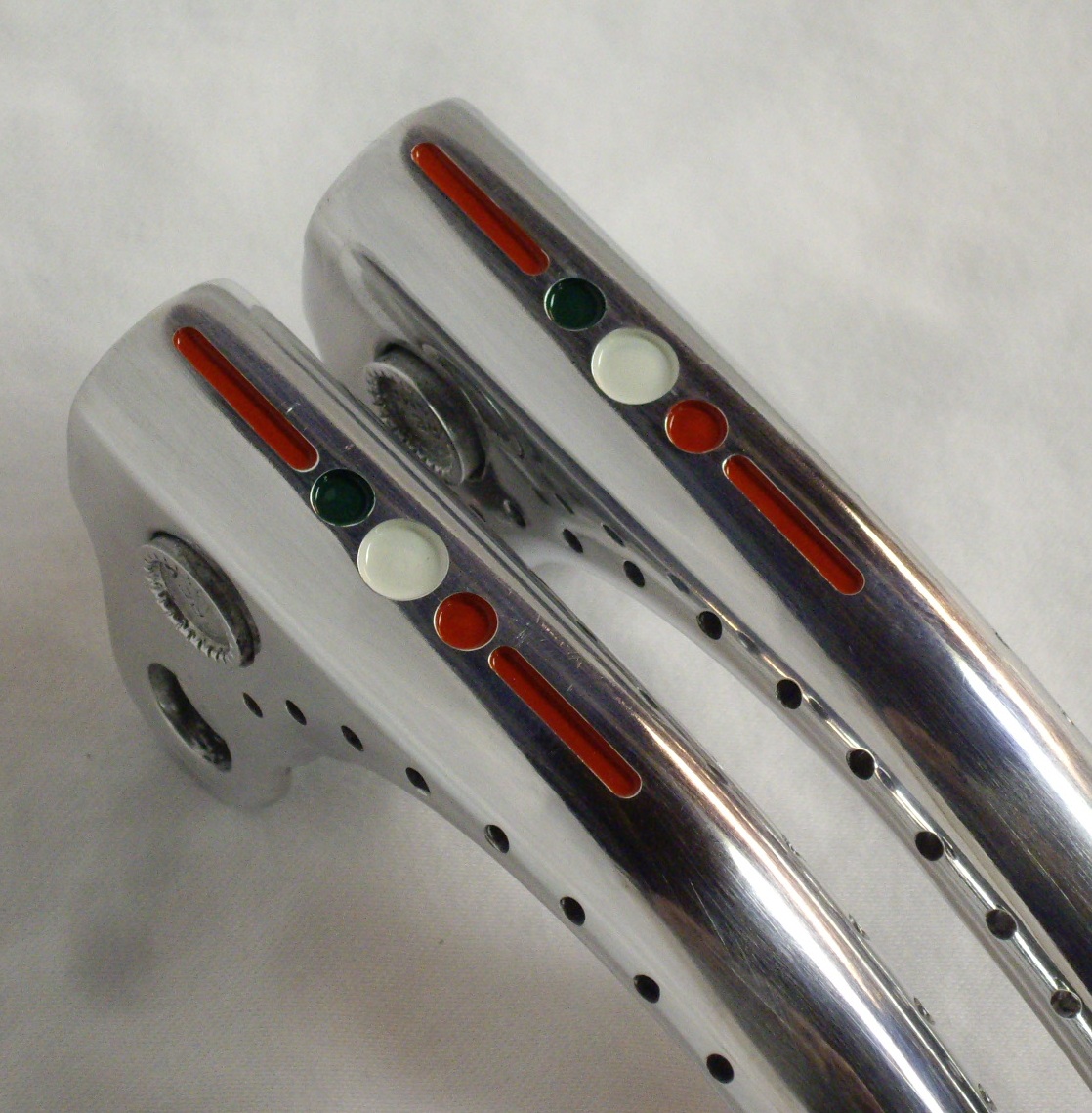
For my 1974 Carlsbad Masi, I wanted to use the Faema team colors of the style used when Eddy Merckx rode for Faema. Jon keyed off the Italian flag colors of red, white and green to complement the Faema color scheme.

One side benefit to having parts drilled and milled for your bike is that older scratched up parts are sanded and polished, often yielding a part that looks better than new.


Jon has a talent for coming up with unique and different schemes for each bike. His Flickr images are well worth a look:
He can be contacted at DrilliumRevival@Yahoo.com