Friday, February 21, 2025

Gravel bike conversion to electric

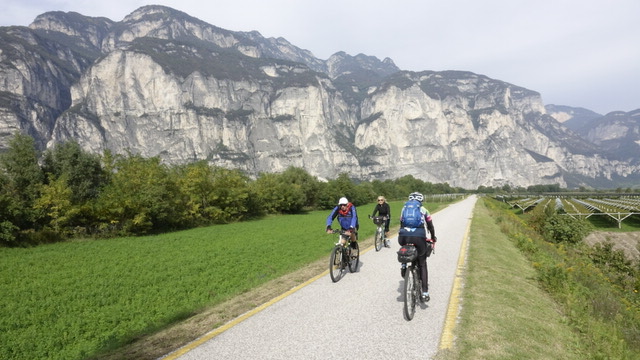
We have enjoyed multiple bike trips to Italy riding the dedicated separated bike trails of the Veneto region. While there, we were introduced to the Refugios that are perched high in the mountains. They are mountain huts but that name does not do justice. A refugio will have simple dorm accommodations and a nice bar and restaurant with simple but satisfying meals. Usually they have a nice deck to enjoy sunrise and sunset from a spectacular view high in the mountains. Many people take advantage of being able to hike from refugio to refugio with minimal equipment and mountaineering experience. 

These refugios are often maintained via gravel roads that wind from the lowlands up to the high reaches. What a great idea to cycle from refugio to refugio. Many refugios also embrace ebikes by providing charging stations.

So I decided to try and convert our gravel bikes to bikes that could handle the rough gravel access roads that sometimes border on mountain bike single track. Many of the roads have quite a climb and I decided we needed a little help to get to the peaks.

There are multiple ways to create an electric bike from a standard bike. I wanted a stealth approach because of my own bike aesthetic. The rear hub motor method can employ a hub motor that requires the replacement of the rear wheel but otherwise no further modifications are needed. Some of the rear hub motors are so small in diameter that it is hard to tell they are a motor.

  I ran into a stumbling block with the first conversion because even tho' the bike was a carbon cyclo-cross bike it was old enough not to have the required 135mm rear axle spacing required of the available hub motors. So I found a frame at a surplus supplier randombikeparts.com, in Minnesota. It cost $199 and was a quality aluminum frame that would fit the bill. I ordered a Sutto 250w 36v rear hub motor kit for $380 which included everything I needed. There are many misconceptions in DIY ebike conversions and a lot of people who want powerful electric motorcycles for road riding. Which is fine but that is not what I wanted.  The 250 watt motor is more than enough power to assist in climbing the Italian Dolomites. It is very compact and relatively light (for ebike motors). 


The kit included a complete rear wheel with the motor, controller, display, cables, headlight and special brake levers that cut the motor off when you are braking. The motor controller manages the motor. I already had the battery from a previous project.


I put the bottle battery in the trunk bag. The frame bag has two zippered compartments and I put the motor controller in the bottom and used it as a cable hub to route cables around. 


From the cable hub I ran the single multi-purpose cable up to a stem bag (below) that I used as a forward cable hub. The single cable then branches to plug in the display, the brakes, the headlight and a sensor that stops the motor when shifting the derailleur.


I put on a Rockshox Paragon fork to help absorb the bumps on the gravel roads and added a dropper post primarily to make it easier to get on and off the loaded bike. The tires are 700x40 wide gravel tires.

It was a nice option to add the rear taillight and the lights are controlled right from the display. They are not the extremely bright lights commuters use but for the times when you are late in getting to your destination before dusk they will work very well and they are powered by the ebike battery.

The bikes perform better than I expected and have about a 40-mile range with the small bottle battery.  Like our eMTBs, these electric-assist gravel bikes will give us access to rides we normally would not be able to do. They make riding more fun. In our first outings riding against a strong headwind was not an issue; it neutralized the headwind.

The bikes won't go anywhere unless you pedal and you can control the level of assistance.

There is a "dark" side to this project. No airline will transport a used ebike, period.

You can't ship them via courier either. Renting an ebike in Europe is an expensive proposition at around 100 euros a day. That is not practical for us. When we go to Europe we stay for as long as we can to make the trip worthwhile. But I think I have figured out a legal and safe way to transport the batteries for this eGravel bike project. 

I will describe my transportable battery solution in the next article.


Sunday, January 19, 2025

Thursday, January 16, 2025

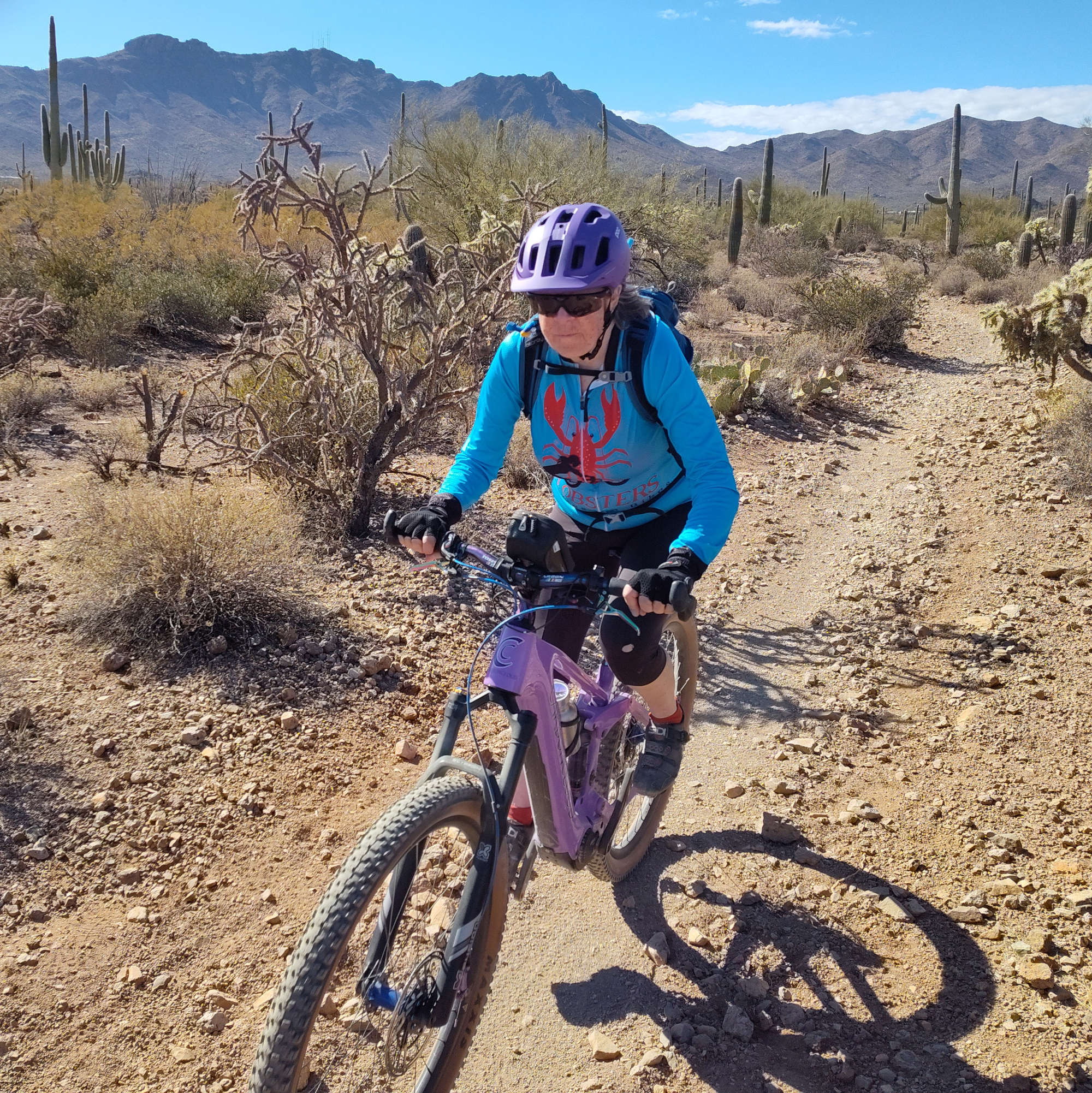
Wild Lobsters spotted in the Sonoran Desert

Sweetwater Preserve, Tucson Arizona


Saturday, January 4, 2025

Tortolita Preserve West

 The Tortolita Preserve, in Marana Arizona, trail system wanders up and down arroyos making an interesting and fun ride.


Wednesday, December 18, 2024

Winter riding in the Sun

When the temperatures in the upper midwest drop below freezing the sun is warm and the sky is blue in the Southwest. There is riding to satisfy every skill level of rider in Tucson, Arizona. 

The Sonoran Desert Saguaro forest is a lush habitat of survivors. Plants and animals evolved in many different ways to high temperatures and low water.

One of our favorite trails is at the Tortolita Preserve in Marana, AZ.


Thursday, February 24, 2022

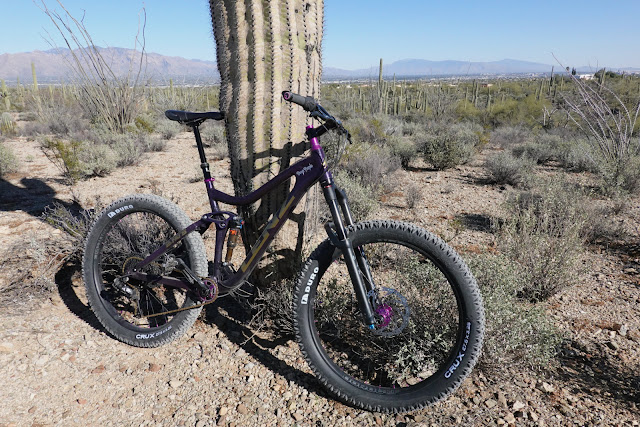
What do you get when you cross a Fat Bike and a MTB bike = B-Fat the Devin Lenz Fatillac


For traveling I have found that I just have too many bikes. Each with a specific purpose, they do a great job for me but it is just not possible to bring them all along.

I also have found I am needing a little more suspension to cushion my spine when mountain biking. So in doing some research I found the Mid-Fat or B-fat category of bike. These bikes sit smack between a Fat snow bike and a mountain bike.

They can generally support a 26x4.6 or 27.5x3.8 snow tire and for summer a 27.5x3.8 or 29x3 tire for trail riding. It makes for a very versatile  general purpose do everything off-road bike. This new bike and my Carver Gravel bike together let me do any kind if riding I want and it fits on top of the car.

The frame I found is made by Devin Lenz in Colorado. He is a builder that specializes in 29'er and snow-ski bikes. He has been building for years and knows his business.

I was concerned about buying a bike unseen and unridden but luckily this bike fits me perfect and I really love riding it. I have been a big fan of plus sized tires since I got my Carver Gnarvester 29+ and this bike continues that tradition.

It is time for me to simplify and this bike helps allow me to continue to ride the trails I like without the baggage of too much stuff.

Take a look at Lenzsport:

https://lenzsport.com/

Monday, October 12, 2020

Converting a Cyclocross BIke to Gravel using the Kona Jake CX


Converting a older cyclocross bike into a gravel bike can be a great way to get into gravel riding without the harsh price tag. Cyclocross racing bikes are essentially gravel bikes with one big exception. Cyclocross has always been happy with around 32mm tires when the new world of high performance wide tires allows gravel riders to use much bigger tires. So determining if your cyclocross to gravel conversion candidate is a good choice is finding out what the widest tires that can be used. That is not always an easy task. Previous owners may have never used anything over 32mm tires so they may not know what will work. 

Do some google searches for your choice and see if you can find any posts from people who have used your candidate for a gravel conversion.

In this case my choice was the 2012 Kona Jake CX offered on ebay for $689. I found references that it might support at least a 700x40mm tire. It turns out it supports a 700x43 with room to spare. It makes a great cross to gravel conversion.


Wednesday, August 5, 2020

Carver ALLROAD custom titanium gravel bike


I found I loved gravel biking through Germany and Italy on my Cinelli Zydeco gravel bike but I hated the disc brakes. They just plain don't work as well as rim brakes despite lazy journalists repeating the marketing hype over and over until people believe it.

Since the disc brakes are so bad I had to find an alternative but it is not easy. The marketing world has converted everyone to road bike discs whether they want it or not. It is hard to find rim brake rims, rim brake hubs and rim brake forks.

I finally went to Davis Carver to see if he could build me a gravel frame with cantilever studs. He said sure. So I snagged the last new old stock Enve cantilever fork on the planet and waited for my frame. I like working with Davis because he does a great job of communication and he checks my requests for foolish mistakes. He also delivers incredibly fast by custom bike standards at just 90 days and his prices are very competitive.

The frame arrived as promised and I set it up with Hope RS4 rim brake hubs with a campy cassette in 135mm spacing. I laced them to HED Belgium plus rims and mounted Gravelking 700x50 tires. The frame had plenty of clearance for the tires but I had to get a number of examples of V Brakes to find a pair that had adequate clearance.


It rides beautifully. It feels road bike responsive on the road and is cushy comfy when I dive off the pavement. It fits me perfectly and it is fun to ride on the road but also on anything including mountain bike single track, to the point that you really need a suspension fork due to drop-offs.

So if you have not discovered gravel biking you owe yourself to find out what it is all about.

Davis Carver can be found at bikeman.com and he offers two different gravel bikes. The Asian made ALLROAD I purchased and an American made Gravel frame. I choose the Asian made offering because of the wide variety of options you can select, like my cantilever studs, the travel couplers and custom geometry.


Saturday, December 14, 2019

Gravel Biking in Germany Austria and Italy


We did our first major cycling trip with our new gravel bikes. I LOVE it!


In previous years we have enjoyed the fantastic dedicated bike paths in the Veneto region of Italy. These are paths that are separated from the road, paved and wander through vineyards and apple orchards for hundreds of miles.

I found an online tool called Komoot at www.komoot.com. Komoot does for hikers and cyclists what google maps does for cars. It's a router that allows you to set a starting point and a destination and then it will find a route for you based on whether you are a hiker, a road cyclist, a mtn biker or, in our case, gravel cyclists.


The fantastic thing about this is that Komoot sewed together the separated bike paths with small roads, gravel trails and vineyard paths to create a route that was 600 miles long and was 70% separated from the road. We got very spoiled not having to ride with traffic. The route took us from Munich, Germany through the Austrian Alps and over the Italian Dolomites of the Alto Adige.


The walled city of Mariostica, Italy

This was a very different trip than we've done in the past because we embraced the ultralight backpacking techniques that bikepacking has borrowed from backpacking. In previous trips we used our folding road bikes and pulled trailers which weighed about 60lbs. This trip we used bikepacking bags and all our gear and bags weighed 25lbs. That light-weight setup makes a huge difference when you're climbing.


I'm totally sold on gravel biking. The siren song of these new gravel bikes is a tune that speaks of lightweight road bikes with quick, fun responsive riding but with wide tires that can go anywhere. The paths we traveled went from smooth pavement to almost mountain bike gnarly and the bikes did a great job in every trail condition. On the pavement they still felt like performance bikes rather than heavy touring tanks. Yet, when you head off the pavement, they are still fun to ride and give you a secure connection to the surface.

I could easily give up all my bikes for my one gravel bike. Except for the brakes. I believe that disc brakes for road bikes are a con job created by marketers to get people to spend more money on brakes that are inferior to what we have been using for decades successfully. I hear the same lies being passed all over the internet about how superior disc brakes are on road bikes. It is my experience that it is just not true.  After spending months adjusting and trying to get the disc brakes on my gravel bike to even function at all, and taking the bike to multiple bikes shops to see if they could make them work, I have given up. In the Alps the rotors on the disc brakes got so hot going down long descents that my gloves would smoke on contact when checking the rotors for overheating while stopping every 100 yards to let them cool down. The brake pads lasted only one long ride before they would have to be replaced. This is on rides we've done before with caliper or v-brakes and with heavier loads without incident.

So I am getting a new gravel frame built with V-Brakes.


I highly recommend gravel bikes and gravel biking. It is a way to get off the road onto paths that are peaceful and safe without having to deal with car traffic.

Friday, May 12, 2017

Windcheetah Recumbent Trike


An ancient Greek philosopher by the name of Heraclitis claimed that "All things are fire". I never understood that when I was young. But after a few decades under my belt I began to understand that change is constant. You can either learn to adapt or curl up in the corner and sob. I am not saying all change is good nor do I believe that "you can't fight Progress".

One of the difficulties of being passionate about something, like I am with cycling, is that if you lose that thing it can be devastating. As I age and things don't work as well as they did when I was twenty I am looking for ways to adapt.

When I was twenty all I saw and lived were racing bikes. Narrow high pressure tires, 4 inches of seat to handlebar drop and a 53/42 front chainset. The recumbent trike would have looked pretty weird to me in those days. But these days it looks pretty darn good.

The benefits of the recumbent trike are many. First it almost eliminates pain from your arms and hands having to rest on the handlebars. You have a panoramic view of the world without bending your neck. No looking at a patch of asphalt 6ft in front of you all day. You can stop on a hill and start right back up again.

It is so different than riding a bike that it seems closer to kayaking to me. Kayaking is wonderful because you are low, right next to the water. You get to see the world and it's critters up close and quietly.

I am not ready to give up my bikes yet but I got the trike as an insurance policy for that day when I must give them up.


The Windcheetah was designed by Mike Burrows back in the early 1980's. He has always been into Human Power speed racing and needed a way to train in the winter safely. He designed the "speedy" as a recumbent racing machine and just added another wheel to the front to make it more stable in the ice and snow of winter. But the speedy became popular because it is a different kind of cycle that had interest to people beyond speed records.


Mike Burrows went on to design the  record setting Lotus superbike for Chris Boardman and worked for Giant designing the very successful TCR road bike. He sold the company when he went to work for Giant.


Windcheetah is currently owned by Karl Spartenburg and he builds Windcheetahs to order for each customer in England. There are many recumbent trikes on the market now made all over the world but the Windcheetah design has survived the test of time.


It is narrow and fast. A real kick to ride. In fact I may not wait till I can't ride bikes anymore. It's too much fun to wait.


Monday, April 10, 2017

More Millium and more Drillium

04/2018
I am very sorry to report that Jon Williams died suddenly of a heart-attack while riding his bike. He was a special guy. As talented a fine art woodworker as he was a machinist and a Music lover. He will be missed by the whole bicycle community he was so much a part of.
********************************************************************************

One of the more popular articles on this blog was the article about Jon Williams of Drillium Revival. Jon's take on 1970's Drillium and Millium is an artform in itself. His ability to bring a unique treatment to new customers is one of his strong points. But I wanted to show some of his new work which takes newer components that are much more modern and yet applies the Millium and Drillium. The results are not retro poured over the top of modern but instead and new take on modern. More on his Flicker Pages.

If you would like a truly personal and unique set of parts for your new bike you owe it to yourself to chat with Jon: drillium@yahoo.com


Friday, March 31, 2017

Sandhill Crane Migration on the Platte River

For 9 million years the Sandhill Cranes have been stopping by the Platte River to rest and refuel on their migration from the warmer southern winter grounds and their summer nesting sites in the north. Did you get that number? 9 million. How long have our ancestors existed on this planet?

They come from wintering grounds coast to coast and all fly into the middle of the country around Kearney, Nebraska. This year about 400,000 were counted at the peak. To be honest I never thought I would visit the plains. I am a west coast guy raised backpacking into the Sierra Mountains.

But this event is something worth taking a break from your urban insanity and sit quietly in a field and listen to the sound of a 9 million year tradition.

Get started by stopping by the Crane Trust or the Ian Nicholson Audubon Crane  Center at the Rowe Sanctuary.


They are both easily accessed from Interstate 80.
There is no cost to drop by and the volunteers are waiting and ready to help you learn about Cranes. You are welcome to drop a donation in the box if you would like to help support their work. Each operates blinds that allow viewers closer access. There is a small charge and you need to sign up in advance to be sure of getting a spot in the blind. But for me the grandeur of the large groups flying and soaring together is the main attraction.

The Cranes start arriving earlier each year. The peak was in early March but good viewing extends through the end of March. Individual cranes might stay for a month gleaning the fields of insects and left over grains.


At night they fly back in groups to the Platte River for a safe place to sleep. Cranes can't swim so that is why the Platte River is so important. It is known as "being a mile wide and an inch deep".


When they feel ready to move on north they begin to join up with large groups staging to fly on. The groups soar in circles, called "kettling" gaining altitude to find a warm current heading in the right direction. Cranes will return to the same nesting grounds year after year.


So what has all this got to do with cycling? Well the Crane trust has a fleet of Surly Moonlanders and take folks out on Fat Bike excursions. Contact the excursion manger Ben Dumas at 308-384-4633 for more info. Because there is a lot more to see in Nebraska than just Cranes.


Sunday, January 22, 2017

Bikepacking

bikepacking.com
Bikepacking

One of the current activities in cycling with a lot of “traction” is bikepacking. I think the earliest forms of bikepacking were practiced by mountain bikers wanting to do overnight trips via single track. They needed to carry their camping gear in a different way than traditional bike tourists. Bike tourists generally carry their gear in bags hung from racks that straddle the front and rear wheels. But the early bikepacking adopters could not ride narrow, tight single track trails with bags hanging off the sides of their bikes. So they developed bags to carry their gear that fit in the gaps of their bike frames and were less likely to snag branches and such along the sides of a trail.


Today, bikepacking has morphed into many things. I think my definition will be that bikepacking is to traditional bike touring what ultralight backpacking is to backpacking. Today, you might see road tourists or gravel road tourist using bikepacking bags as well as single track mountain bikers. It is a simpler, lighter camping setup than the traditional tourist who might “bring the kitchen sink.”


Bikepacking is about shaving off grams and square inches from your camping overhead. So let's look at the spaces on the bike and what we might put into them.

Generally, nothing is placed straddling the front wheel (like the front rack and panniers on a traditional road touring bike) because a mountain bike often has a front shock which moves up and down.


Starting in the front, we have the space traditionally occupied by the handlebar bag stuffed between the sides of dropped road handlebars. But on a mountain bike the handlebars are wide and don't limit the width of a bag. It turns out to be a good place to put the largest of items, which usually is your sleeping bag, pad or tent or maybe all three. Often, a small bag is also attached on the outside to store quick-access items like snacks.


Behind the stem or on the stem or hanging from the inside of the bars are a variety of little bags designed to stuff something small into. Same going back to the seatpost. Behind the seatpost is a long thin seatbag which is often used for clothes.


The center piece of bikepacking storage is the frame bag. The trouble with a frame bag is that the space in the inner triangle of a typical road bike or mountain bike can very greatly in available room and the shape of the bag. Some mountain bikes have rear shocks that protrude into this space. On some bikes the only water bottle cage locations are in this triangle. Some small frames just don't have any available space here at all. So although you can buy most bikepacking bags off-the-shelf many riders get the frame bag, at least, custom made to fit their bike.

One nice thing about the beginning stages of a new thing like bikepacking is that the big boys, i.e. corporations, have not gotten into the game yet. This is a time of innovation when lots of small players are making their bid for success. Unlike more established aspects of bicycling, there are lots of people currently making custom bikepacking bags. It is a wonderful time to get something made by hand, just for you, that is made by a craftsman rather than a big machine in the far east.

I did some research on the web and found a post on the mtbr.com forum for “Bikepacking and Bike Expedition” titled “Bikepacking gear bags - who makes 'em?.” This post turned out to be a permanent list of bikepacking bag makers and their contact information:
http://forums.mtbr.com/bikepacking-bike-expedition/bikepacking-gear-bags-who-makes-em-766873.html

I studied the list and went to some makers' websites. I was looking for someone who did custom work and might be open to using fabrics I picked out and would let me suggest some attachment ideas I had.

www.rockgeist.com


I chose Rockgeist in North Carolina owned by Greg Hardy. I was lucky. Greg turned out to be responsive to queries, willing to listen to my crazy requests and a consummate craftsman. He produced very high quality bags in a month and was willing to incorporate some of my requests. The cost was no more than production bags. I highly recommend him at www.rockgeist.com.


The first time I looked at a set of bikepacking bags I could not believe anyone could get  enough camping gear in the bags for a weekend let alone a longer trip. But when I switched my thinking from “camping” to “ultralight backpacking” I began to see the light. When I was a kid I went backpacking in the Sierra Nevada mountains and in Colorado when ever I could. Even though I went “light” my pack often weighed in at 50 lbs. Nearly a half century later I can't carry that kind of weight on my back anymore. So I found out about ultralight backpacking which allowed me to continue to do something I loved at half the weight.

You do have to be willing to change your thinking about what is necessary and certainly do away with the word convenient.  I can't talk about ultralight backpacking techniques anywhere near as well as Mike Clelland of Falcon Guides. I really like his gear tutorials on Youtube.com, like his “Ultralight Tips” https://www.youtube.com/watch?v=G4O_I22rKp0

One nice thing is he talks about many inexpensive solutions for ultralight touring and they are all applicable to bikepacking. There are also some new very high tech solutions from the typical manufacturers.  I use a MSR tent named the carbon reflex which is lighter than a simple tarp with room for three.


Using ultralight backpacking techniques you can indeed design a system for bikepacking that is comfortable and will fit in your bikepacking bags. It will allow you to explore some spectacular, out of the way places on your bike.

Like the Colorado Trail.
https://www.youtube.com/watch?v=j8GSZtfLJNE

Some great resources online are www.bikepacking.com and www.bikepacker.com .